
THE LILY, GILDED
"Easy Rider", The Big Easy, and uneasy times

This month’s issue arrives on a significant date. 250 years ago today, representatives from 13 of Britain’s colonies signed a document detailing grievances against England’s King George III. Unable to resolve their concerns, the delegates concluded that “these united colonies are, and of right out to be free and independent states”. British troops would not withdraw until 1781; the “United States” would not exist as a polity until the constitution was ratified eight years later. Conventionally however, the 4th of July is celebrated as the birthday of the USA.
We can’t deny that the Declaration of Independence had an enormous global impact. It’s also safe to say that across the pond many are contemplating more recent history. Sixty years ago, England hosted the FIFA World Cup tournament. On 30 July 1966, The Three Lions defeated West Germany to win their first – and to date, only – World Cup title.
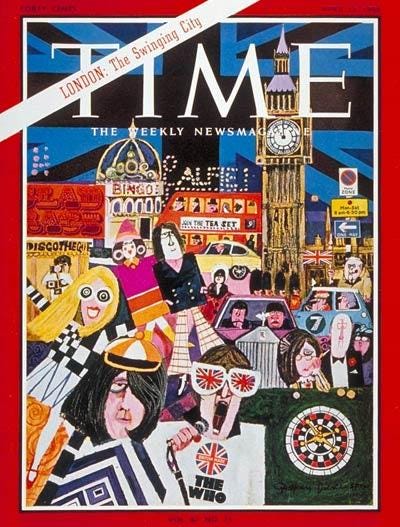
The match was broadcast to television audiences in black & white, the last time this would be the case. Beyond the telly, Britons were enjoying a colorful year indeed. In April, Time Magazine ran a cover story entitled “The Swinging City”. It read, in part, that during “a decade dominated by youth, London has burst into bloom…it swings; it is the scene.”
Mod fashions by Mary Quant and other designers set a sartorial flair. Their garments graced the figures of models like Twiggy and Jean Shrimpton. The general public – those who could afford to do so – patronized boutiques along Carnaby Street and The King’s Road. In different ways, British cinema captured aspects of the zeitgeist. There was Alfie, starring Michael Caine, and Georgy Girl, nominated for 4 Academy awards. Blow-Up was directed by Michelangelo Antonioni, the Italian auteur’s first English-language film.
And of course, there was music. Less than a week after England’s triumph on the pitch, The Beatles released Revolver, often praised as their best album. The LP fuses a perfect pop aesthetic with elements of the nascent acid rock movement. “She Said, She Said” is perhaps the most lysergic track. Despite the titular pronoun, the song was inspired by a conversation John Lennon had with Peter Fonda.
The previously year, they met at a party in Beverly Hills. The Scouse singer and the American actor were both high on LSD. Fonda recounted that as a boy, he accidentally shot himself. On the operating table, his heart briefly stopped beating. “I know” he declared, “what it’s like to be dead”. Lennon, in the parlance of the times, found the anecdote a total bummer.
Fonda was part of a Hollywood dynasty. His father Henry played Tom Joad in the film adaptation of Steinbeck’s The Grapes of Wrath, and portrayed such historic figures as Abraham Lincoln and Chester Nimitz. Peter’s sister Jane would take home Best Actress Oscars for Klute and Coming Home.
Despite this pedigree, in the 1960s Peter Fonda starred in two films directed by Roger Corman. Incredibly prolific, Corman worked across many genres -- science fiction, horror, beach party flicks – but his features were generally low-budget affairs. In The Trip Fonda played a commercial photographer who experiments with mind-altering substances. The following year, in The Wild Angels, he was cast as the leader of a motorcycle gang. Lurid portrayals of bikers had been a box office staple since Marlon Brando appeared in The Wild One.
Superficially, 1969s Easy Rider combines aspects of both Corman productions, but it is a very different sort of film. There are drugs, there are motorcycles, but sensationalism is toned down. Fonda portrays Wyatt; he is also listed as producer. Dennis Hopper served as director and costars as Billy. The two shared writing credits with novelist Terry Southern.
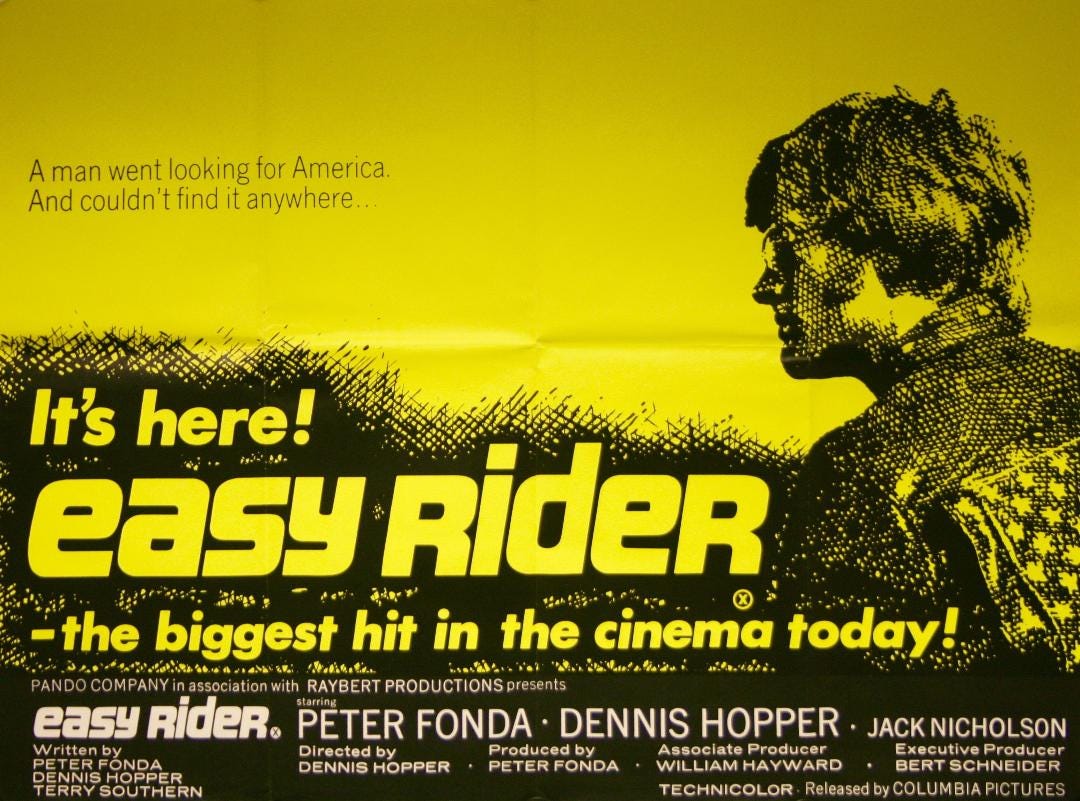
In the opening scene, Wyatt and Billy ride up to a cantina in Mexico. Engaging in illicit arbitrage, they purchase a large quantity of cocaine. Returning to Los Angeles, they sell the powder to The Connection, played by record producer (and convicted murderer) Phil Spector. The transaction nets the partners a significant profit. Celebrating their windfall, they set out to enjoy Mardi Gras in New Orleans.
With its innovative use of popular songs, the soundtrack of Easy Rider made cinematic history. There are tunes by Roger McGuinn, The Band, and Jimi Hendrix. Most iconically, the credits sequence features “Born to Be Wild” by Steppenwolf. The song lasts just a little more than 3 minutes, but probably did more to promote the ideal of motorcycling than Harley-Davidson’s marketing department accomplished in decades.
Smuggling contraband across an international border means our protagonists are, by definition, outlaws. But the movie is successful to the extent that it subverts biker movie cliches. Wyatt and Billy evoke Tom Sawyer and Huckleberry Finn, the “Road To” comedies of Bing Crosby and Bob Hope, Sal Paradise and Dean Moriarty .
Fonda’s character in The Wild Angels is a sadistic thug. He dresses the part, with black leather and an Iron Cross around his neck. By contrast, Wyatt’s helmet and fuel tank abound with the Red, White, and Blue. Old Glory adorns his jacket. Billy even refers to him as Captain America. The pair are decidedly not gang members. Throughout the 1950s and 60s, youth subcultures were generally depicted as undermining the decent values of their law-abiding elders. Easy Rider turns that equation inside out, suggesting the paranoid conformity of postwar American society posed an existential threat to younger citizens.
At an early point in their picaresque journey, Wyatt and Billy stop at a motel. They have cash in hand, and could reasonably expect the kind of amenities long offered to motorists. But before they can check in, the proprietor switches on the “No Vacancy” sign.
Such hostility was not limited to the big screen. Hopper recalled “It was dangerous because there these marines who wanted to take me apart because I had long hair. You’d hear a lot of stories at that time about guys getting cut with razors and things. It was so bad that we skipped going to Texas”.
Across the globe, the 20th century was a time of technological and political upheaval. Faced with the destruction of World War II, the horrors of The Holocaust, and the peril of nuclear annihilation, many found traditional belief systems inadequate. On the world stage, the United States was wealthier and more powerful than ever. Domestically, a number of discrete changes contributed to widespread social anxiety.
Before the war, The Great Migration brought millions of Blacks from southern states to cities in the northeast and the industrial Midwest. The G.I. Bill, passed in 1944, provided low-cost home lans for returning veterans; terms of the legislation favored new construction over existing stock. The Federal Aid Highway Act further hastened “white flight” and turbocharged suburbanization. Americans coming of age in this era often did so in atomized communities, while those who remained in city centers found basic services curtailed.
In 1945, there were fewer than 10,000 television sets in the USA. Within 5 years there were six million, a figure that saw a tenfold increase by 1960. The family living room, rather than the cinema, became the main locus of entertainment. It would be too much to assert that the subversive influence of Eddie Haskell or Maynard G. Krebs inspired a generation to “Turn on, Tune in, Drop out”. But the centrality of network TV highlights broader trends.
The Great Good Place, a book by sociologist Ray Oldenburg, discusses the importance of “third places” between the home and workplace. He asserts that theaters, restaurants, bars, and hair salons can all serve to bolster democracy, civic engagement and a sense of belonging. All too frequently, a paucity of viable third places has proven a hallmark of suburbia. In this light, it is hardly surprising that by the mid-60s, young Americans flocked to Venice Beach in Los Angeles, Manhattan’s East Village, and the Haight-Ashbury district of San Francisco.
En route to the Crescent City, a flat tire requires a pit stop at a small ranch. Repair completed, Billy and Wyatt are invited to stay for lunch. Learning his guests are from Los Angeles, the rancher admits “when I young, I was headed to California. Well, you know how it is” he says, gesturing to his kids. “My wife is Catholic, you know”. Wyatt responds, “It’s not every man can live off the land. You do your own thing in your own time. You should be proud”.
Later, they encounter a hitch-hiker who offers gas money in exchange for a ride to the commune he calls home. There, they experience rural hospitality of a different sort. The rancher had admired the machinery of their choppers; the assembled hippies eschew even basic farming implements, manually scattering seed onto arid soil. Some of the rancher’s children had their host’s sandy hair, but others more closely resemble his young Mexican wife. By contrast, the commune dwellers are all decidedly Caucasian.
In a small western town, locals are assembled to watch a marching band. Wheeling their machines behind the majorettes, the two bikers are arrested for parading without a permit. Waking behind bars, they meet George Hanson, played by Jack Nicholson. A young attorney with a drinking problem, George is treated with deference by the jailers, no doubt due to his family’s influence. Learning of his affiliation with the ACLU, Billy asks if he can help secure their release. “I imagine I can, if you have haven’t killed anybody” Hanson replies. “At least, nobody white”.
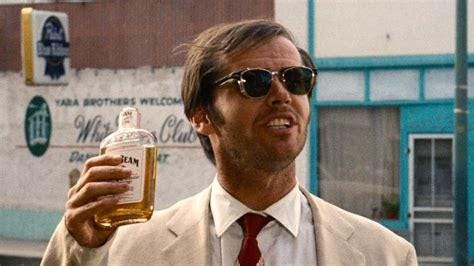
Outside the police station, George greets the day with a swig of Jim Beam. Passing the bottle to Billy, he reveals “I must have started out to Mardi Gras six or seven times. Never got further than the state line”. From his wallet, he produces a card given to him by Louisiana’s governor. Bearing a French Quarter address, the card advertises Madame Tinkertoy’s House of Blue Lights, purported to be “the finest whorehouse in the south”. Wyatt invites him to come along for the ride. The lawyer retrieves his high school football helmet, and the trio heads east.
It is significant that George Hanson is the only character whose last name we learn. Nicholson’s screen time is relatively limited, but he articulates the film’s central message, such as it is. Stopping to eat at a luncheonette, the woman behind the counter makes no effort to serve the out-of-towners. Their long hair and colorful clothing offend the other patrons. “They look like refugees from a gorilla love-in”, one man remarks. Ridicule gives way to threats, and the three make a hasty retreat.
That night, around a roadside campfire, George muses “This used to be a hell of a country. I can’t understand what’s gone wrong with it”. Billy says “Everybody got chicken”. Hanson continues:
They’re not scared of you; they’re scared of what you represent to them. What you represent to them is freedom…talking about it, and being it, are two different things. It’s real hard to be free when you are bought and sold in the marketplace. ‘Course don’t ever tell anybody they’re not free because then they get real busy killing and maiming to prove that they are. Oh yeah, they’ll talk to you and talk to you and talk to you about individual freedom, but they see a free individual, it’s gonna scare them.
“Well,”, says Billy, “It don’t make ‘em running scared”, and George concurs: “No, it makes them dangerous”.
How dangerous? Without wishing to give too much away, Mr. Hanson doesn’t make it to Madame Tinkertoy’s after all.
For Wyatt and Billy, their quest culminates in New Orleans, but the footage shot there actually predates the rest of the production. Investors Bob Rafelson and Burt Schneider gave $40,000 to capture the Mardi Gras action, with an understanding more funding would follow if they liked what they saw. But Fat Tuesday is a “moveable feast” and Fonda initially miscalculated the dates. Realizing his error, the cast and crew arrived at the last minute without permits or proper equipment. According to cinematographer Laszlo Kovacs, Hopper “rented 10 Bolex 16 mm cameras, gave them to the actors, and asked them shoot street scenes with color positive film. It doesn’t match, but it’s Mardi Gras and kind of psychedelic, so no one notices”.
The two bikers treat themselves to a fancy dinner before proceeding to the bordello. There they engage the services of Karen and Mary (played, respectively by Karen Black and Toni Basil). The quartet carouse through the crowded streets, swallowing tabs of blotter acid. Even for the dedicated hedonists reading this, blending powerful hallucinogens with the sensory overload of the yearly bacchanal may seem a bit like gilding the fleur-de-lis.
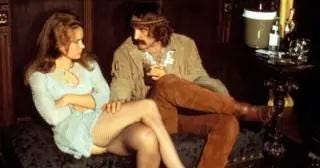
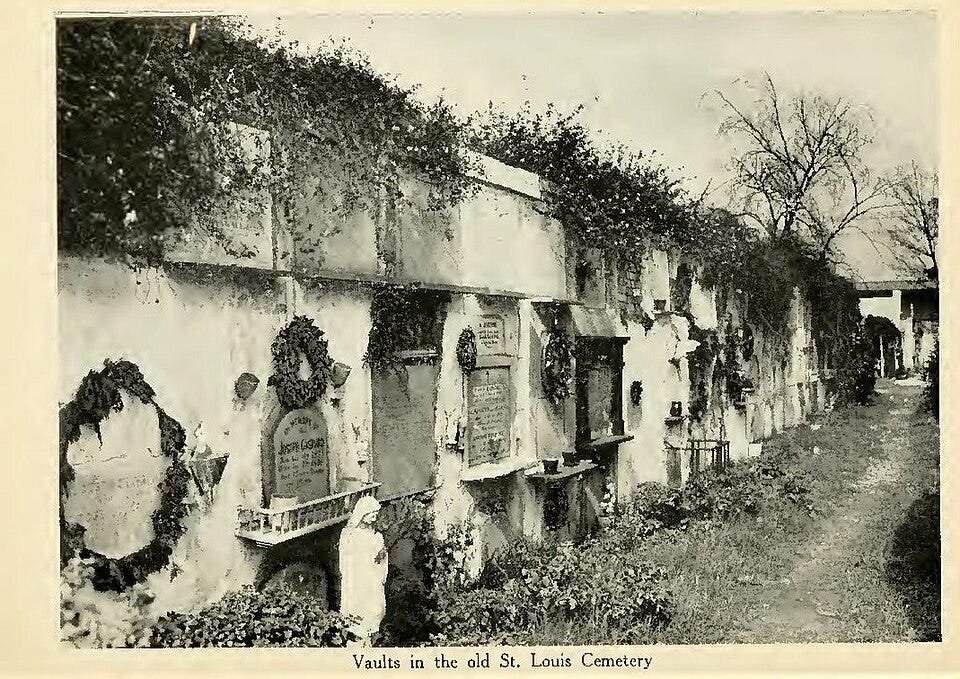
Eventually they make their way to the famous St. Louis Cemetery #1. The sequence is powerful and disturbing in turn. The site was and remains consecrated ground. To this day, many New Orleanians – even those who are otherwise fans of Easy Rider – strongly object to the depiction of nudity, booze, and drug use among the historic crypts and monuments.
So, what is it is about Mardi Gras that so fascinated the characters, and inspired their transcontinental trek? In this, as in so many things, the script is ambiguous. Of course, it is a loud, raucous street party, and that surely accounts for part of its appeal – but only part.
In the United States, an organic custom pre-Lenten revelry is limited to the Gulf Coast region. But in countries where The Tradition is more widely observed, Carnival serves many related social purposes. Designing masks and costumes, playing music, or riding on floats provides a creative outlet for many people. It is also an occasion for communal exuberance which (for a few days, at least) cuts across divisions of class and race. And in times of uncertainty, the annual ritual provides a comforting sense of continuity.
At the present moment, that is perhaps the most salient quality. 250 years since that assembly in Philadelphia, 223 years after the Louisiana Purchase, more than a half century since the festivals at Woodstock and Altamont, it may be that Americans need Mardi Gras more than ever.
The way you tie the wonderful, troubling film “Easy Rider,” Woodstock, English football, the Beatles, and more to our 250th anniversary is ingenious. I do think we need the joy of Mardi Gras, music and maybe magic mushrooms more than ever.
I haven't seen the movie in many years, but your review of its many powerful scenes shows how it still resonates today.